Vietnam

  • Centre for Creative Initiatives in Health and Population (CCIHP)

Sri Lanka

  • Bakamoono;
  • Women and Media Collective (WMC),
  • Youth Advocacy Network – Sri Lanka (YANSL)

Singapore

  • End Female Genital Cutting Singapore
  • Reproductive Rights (WGNRR)

Philippines

  • Democratic Socalist Women of the Philippines (DSWP);
  • Galang;
  • Healthcare Without Harm;
  • Institute for Climate and Sustainable Cities;
  • Likhaan Centre for Women’s Health;
  • Nisa UI Haqq Fi Bangsamoro;
  • PATH Foundation Inc. (PFPI);
  • Women’s Global Network for
    Reproductive Rights (WGNRR)

Pakistan

  • Aahung, Centre for Social Policy Development (CSPD);
  • Forum for Dignity Initiative (FDI);
  • Gravity Development Organization; Green Circle Organization;
  • Indus Resources Center (IRC);
  • Idara-e-Taleem-O-Aaghai (ITA);
  • Rehnuma – Family Planning Association Pakistan;
  • Shelter
    Participatory Organisation;
  • Shirkat Gah;
  • The Enlight Lab

Nepal

  • Beyond Beijing Committee (BBC);
  • Blind Youth Association of Nepal;
  • Blue Diamond Society (BDS);
  • Nepalese Youth for Climate Action (NYCA);
  • Visible Impact;
  • Women’s Rehabilitation Centre (WOREC);
  • YPEER Nepal;
  • YUWA

Myanmar

  • Colourful Girls Organization;
  • Green Lotus Myanmar

Maldives

  • Hope for Women;
  • Society for Health Education (SHE)

Malaysia

  • Federation of Reproductive Health Associations of Malaysia (FRHAM);
  • Joint Action Group for Gender Equality (JAG);
  • Justice for Sisters (JFS);
  • Reproductive Health Association of
    Kelantan (ReHAK);
  • Reproductive Rights Advocacy Alliance Malaysia (RRAAM);
  • Sisters in Islam (SIS)

Lao PDR

  • Lao Women’s Union;
  • The Faculty of Postgraduate Studies at the University of Health
    Sciences (UHS)

Indonesia

  • Aliansi Satu Visi (ASV);
  • CEDAW Working Group;
  • Hollaback! Jakarta;
  • Institut Kapal Perempuan;
  • Kalyanamitra;
  • Komnas Perempuan;
  • Remaja Independen Papua/Independent Youth
    Forum Papua (FRIP/IYFP);
  • Perkumpulan Keluarga Berencana Indonesia (PKBI);
  • Perkumpulan Lintas Feminis Jakarta;
  • Perkumpulan Pamflet Generasi;
  • RUTGERS Indonesia;
  • Sanggar SWARA;
  • Women on Web;
  • Yayasan Kesehatan Perempuan (YKP); 
  • YIFOS Indonesia

India

  • CommonHealth;
  • Love Matters India;
  • Pravah;
  • Rural Women’s Social Education Centre (RUWSEC);
  • SAHAYOG;
  • Sahaj;
  • Sahiyo;
  • SAMA – Resource Group for Women and Health;
  • WeSpeakOut;
  • The YP Foundation (TYPF)

Morocco

  • Association Marocaine de Planification Familiale (AMPF),
  • Morocco Family Planning Association
The last lap efforts towards achieving Sustainable Development Goals - APFSD 2026 for Transformation, Equity and Coordinated Actions

– Sai Racherla, Deputy Executive Director, ARROW | Reflections for APFSD 2026

With less than five years remaining to realise the Agenda 2030 for Sustainable Development, and none of the 17 Sustainable Development Goals on track to be achieved in the Asia-Pacific region, the theme of Asia Pacific Forum on Sustainable Development – APFSD 2026 – Transformative, equitable, innovative and coordinated actions for the 2030 Agenda and its SDGs for a sustainable future for all is fit for purpose and APT.

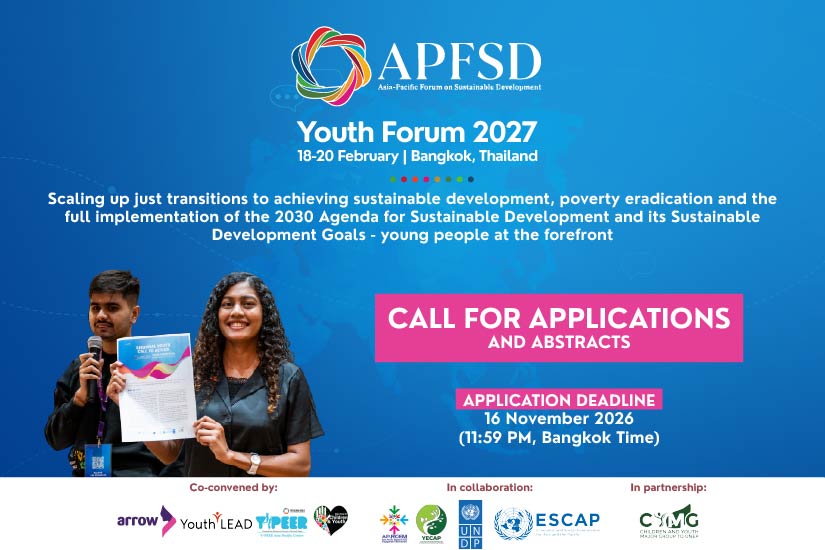
This theme is further reiterated as- Transformative, equitable, innovative and coordinated actions for the 2030 Agenda and its SDGs for a sustainable future for young people in all their diversity, at the APFSD Youth Forum 2026, [i] a dedicated civic space for young people ahead of APFSD follow-up and review of the Asia-Pacific progress towards sustainable development from young people lenses.

This youth civic space has been surviving since 2017 led by the Asian-Pacific Resource and Research Centre for Women (ARROW) and our regional co-conveners. This year we received 2129 applications from young people representing 47 countries. Through a participatory review process, 705 youth scholars (in-person and online) from 38 countries were selected to engage in the regional APFSD 2026 review process.

TRACKING PROGRESS ACROSS SUSTAINABLE DEVELOPMENT GOALS (SDG) 6, 7, 9, 11 and 17 UNDER REVIEW IN 2026

The summary of the Asia and the Pacific Sustainable Development Goals progress report 2026, shows poor progress towards SDGs, with the region missing out 103 of the 117 overall measurable SDG targets, with only 14 targets on track. Further to this, goals key to the SDG pledge of Leaving No One Behind (LNOB) such as Goal 5 (Gender equality) and Goal 16 (Peace, justice and strong institutions), are in a data scarcity web perennially.

Key SDGs under review at APFSD-2026 this year are Goal 6 (clean water and sanitation); 7 (affordable and clean energy); 9 (industry, innovation, and infrastructure); 11 (sustainable cities and communities) and 17 (partnership for the Goals).

The SDGs are interconnected across the social, economic and environmental dimensions, and evidence is pointing to the environment dimensions of SDGs negatively impacting the realisation of all SDGs. Goal 13 on climate action, along with biodiversity loss, emissions and increasing frequency of disasters, are continuously on the reversal for years now in the region, negatively impacting the realisation of other social and economic dimensions of SDGs.

SDG 6: Clean water and sanitation 

The SDG 6 on water and sanitation, under review this year, calls for the need to accelerate progress on all the SDG 6 targets, including access to safe drinking water, water quality, sanitation and hygiene, water use efficiency, all of which have direct impacts especially on women and young people health and well-being. Access to clean water and sanitation is intrinsically linked to aspects of menstrual hygiene, and realising sexual and reproductive health and rights. Access to water and sanitation is also a key enabler for other SDGs, whether it is realising sustainable cities and communities (SDG 11), or Industry, Innovation and Infrastructure (SDG 9).

SDG 7: Affordable and clean energy 

The SDG 7 on clean energy, under review this year, again points to the need to accelerate progress towards access to energy services, energy efficiency and energy infrastructure. Progress on the share of renewable energy is on the reversal with the region significantly reliant of fossil fuels , making affordable, reliable, sustainable and modern energy for all a farfetched goal.

This has impact especially on indigenous communities, women and young people. Gender inequalities in energy access, for example lack of safe cooking fuel options, put women and girls at risk of illness due to indoor house pollution. Data suggests that “women in many developing countries spend on average 1.4 hours a day collecting fuelwood and four hours cooking, in addition to other household tasks that could be supported by energy access.” [ii] This limits their access to education and employment. 

Further to this, SDG 7 targets and indicators, are inherently gender blind resulting in poor gender responsive energy access policies, regulations or programmes. It is urgent that we integrate universal access to energy with gender equality and human rights lenses, and enable the full participation of women, young people , indigenous communities in gender just energy transition contributing to climate crises mitigation and adaptation strategies in the region. [iii]

SDG 9: Industry, innovation and infrastructure 

SDG 9 (Industry, Innovation and Infrastructure), under review this year – again remains off-track with accelerated progress required to achieve infrastructure development, sustainable and inclusive industrialisation and clean industries.

For young entrepreneurs, access to finance for SME (small and medium enterprises) will serve as a great catalyst contributing to economic sustainable development. The region also needs to accelerate progress towards domestic technology development including overall research and development around industry and infrastructure.[iv] Access to ICT and internet is on track to achieve progress, but equity in access is still a question. What is important to note is that the progress on ICT and internet access is uneven, impacting vulnerable and marginalised groups . It is URGENT to also assess the extractive and environmental impacts of digital technologies, infrastructure and industry.

SDG 11: Sustainable cities and communities 

The SDG 11 on Sustainable Cities and Communities, under review this year, is also off-track on progress. The Asia-Pacific region, hosts 54% of world urban population, experiencing rapid urbanisation and being off-track on this goal call for urgent actions. Although there has been progress towards housing and basic services, Asia-Pacific continues to account for a significant share of its population, living in slums and informal settlements.

The region needs to accelerate progress towards urban air quality and waste management in many cities. Disaster risk management policies and the resilience to disasters are seeing a reversal in progress with increasing number of people in the region affected by disasters .

Progress in the region cannot be assessed on SDG 11, indicators of affordable , inclusive , adequate. accessible and safe public transport systems, urban planning including civil society inclusive engagement, green and public spaces , and sustainable and resilient buildings.

Safe and inclusive cities for women and girls , young people and persons with disabilities again continues to remain a farfetched goal.[v]

SDG 17: Partnerships for the goals

Further to this, the crosscutting SDG 17 goal on partnerships under review this year remains off track too with debt sustainability on the reversal. Gigantic efforts are required to accelerate progress towards targets and indicators around tax and other revenue collection, science and tech international cooperation, transfer of technologies, capacity-building for ICT, and a fair multilateral trading system, inclusive of exports of developing countries, and duty-free market access for Least Developed Countries.

What next?

What does a transformative, equitable, innovative and coordinated actions for the 2030 agenda and its SDGs mean to take the leap forward in the Asia-Pacific region towards achieving sustainable development for all?

With only five years to go, we will definitely need tectonic transformative, equitable , innovative and coordinated actions. What can these shifts look like?

Transformative?

Evidence is showing alarming setbacks in environmental sustainability in the region, which is directly impacting all other sustainable development goals (SDGs).  For example, Goal 6 on water and sanitation is directly inter-connected to environmental sustainability. Unless we restore water related ecosystems such as forests, mountains etc, environmental degradation directly threatens water availability, access and quality.

There is an urgent need to put environmental sustainability at the core of transformational sustainable development. Transformation also calls for a systemic and structural shifts , examples being the urgent need to shift from fossil fuels to renewable energy, implementing sustainable urban planning to improve health, mobility, and quality of life, Leverage technology, and scaling up inclusive and open digital ecosystems to enhance education, finance, and governance, strengthening social protection systems, unlocking the power of data , and most importantly scaling up investments in SDGs globally to at least $500 billion per year  and adopting effective sovereign debt resolution mechanisms.

Equitable?

Human rights, equality, equity, and justice including gender and reproductive justice are core to sustainable development. The Asia-Pacific Regional CSO Engagement Mechanism (APRCEM) [vi] is a civil society platform promoting “Development Justice,” a framework designed to reduce inequalities of wealth, power, and resources. It advocates for structural shifts—redistributive, economic, gender, ecological, and accountability—to prioritize marginalized people and environmental sustainability over profit. These development justice frameworks should be at the core of policy and programme implementation.

Similarly, the ARROW  [vii]reproductive  justice” framework integrates reproductive justice within the broader, intersectional frameworks of development justice and SDGs. All these frameworks if adopted by governments will lead to equitable and just sustainable development in the region.

The Agenda 2030 for sustainable development key principle was to leave no one Behind ( LNOB). This is far from achievement. Inequalities in the region are rising rapidly, and what is appalling is that we do not have disaggregated data to assess how or not marginalised groups are optimising the opportunities arising from sustainable development programmes in the region. For example, data disaggregated by age , sex, migration status, rural/urban status, income disability are mostly “ “insufficient- only 1 data point available” or “not available – no data at all ”, with data on persons with disability least captured.

These has implications of designing programme and policies to leave no one behind at country level.  Data continues to remain a critical gaps to addressing EQUITY with only 55% of the only 55 per cent of the indicators for the Goals across the region have at least two data points, which is the minimum required to analyse trends over time.

Data gaps are most  apparent  for Goal 5 (Gender equality) and Goal 16 (Peace, justice and strong institutions), the very goals designed to measure inclusion and accountability. Lack of Dis-aggregated data is the big elephant in the room. Countries need to resource and  strengthen their statistical systems to make evidence-based, targeted policy and programme interventions to leave no One Behind

Innovative?

Innovation has become a necessity in the current turbulent times of disruption, and weakening of the multilateral and political systems. This calls for a reimagining our current ways of working, leading to more inclusive and equitable outcomes, and interrogating  entrenched power dynamics, including in areas such as trade, climate, migration, and disarmament amongst Member States .

We need to move beyond the silos and adopt strategic interventions that create ripple effects across multiple SDGs,[viii] such as investing in equitable digital connectivity, ensuring universal basic income, strengthening health and social protection, a sure bet to eradicate poverty and improve well-being of people.

Women and young people are leading transformation and innovation , in ways never imagined. Women and Young people need to be at the forefront of sustainable development, and this is the innovative way of working . Women and young people need to be meaningfully engaged at all levels- sub-national, national, regional and global. Young people need to be engaged in the policy and programme discussions.

Stakeholders including governments and UN agencies need to step up and invest in meaningful and inclusive women and youth engagement and inclusion.

This is the way to go, in fact the only way to go to achieve sustainable development for all!

References:

[i] The Asian-Pacific Resource and Research Centre for Women (ARROW) and the regional co-convenors, Youth LEAD, and YPEER Asia-Pacific Center (YPEER AP),  Major Group for Children and Youth and Children and Youth Major Group to UNEP (CYMG) and Youth Empowerment in Climate Action Platform (YECAP) are organising the APFSD Youth Forum 2026 from 18-20th February, 2026 in Bangkok.

[ii] https://sdg-action.org/the-lack-of-gender-targets-for-clean-energy-is-harming-women-and-girls/

[iii] https://sdg-action.org/the-lack-of-gender-targets-for-clean-energy-is-harming-women-and-girls/

[iv] https://www.unescap.org/sites/default/d8files/event-documents/2500314E.pdf

[v] https://www.unescap.org/sites/default/d8files/event-documents/2500314E.pdf

[vi] https://asiapacificrcem.org/

[vii] https://www.arrow.org.my/

[viii] https://unsdg.un.org/sites/default/files/2020-01/UNSDG-SDG-primer-companion-piece.pdf

Maldives

  • Hope for Women
  • Society for Health Education (SHE)

Mongolia

  • MONFEMNET National Network